(This post is not going to address the acupuncture-is-BS mistaken thought, because that answer is so long it makes my fingers ache for moxa to think about typing it out. Another day, perhaps!)
1. The Pain Mistake
Much of acupuncture’s press in American media centers around its use in pain. Indeed, the first serious attention acupuncture got in the US was sparked from NY Times’ reporter James Reston’s experience with post-operative moxibustion and acupuncture in China. He had an emergency appendectomy while in China, and he wrote about that experience in a front-page Times article “Now, About My Operation in Peking.” (It’s super fun; go read it instead if you’re planning something boring after this.)
But acupuncture is far more versatile than a simple pain reliever.
Acupuncture is a complete system of medicine.
We often explain it this way: acupuncture treats people, not diseases. That means that no matter who you are or what you’re suffering from, acupuncture is an option for you – not just an alternative or a last-ditch attempt, but an actual, serious, thoughtful medicine.
2. The Nerve Mistake
Acupuncture is not about nerve stimulation. Acupuncture theory is based on a channel system that is neither separate from, nor dependent upon, nerves. These channels connect the whole body and are conduits of qi; points are areas where the qi is accessible.
Qi is not a thing or a substance like blood or sweat. It is a relationship. Qi is the spark of static electricity that shoots from your negatively charged hand as it comes into contact with your positively charged car door. It is a way to look at the all the interactions of the parts of a system and the overall effects or function of that system.
Channels aren’t anatomical parts; their existence depends upon the life they circulate. A corpse, for example, has no channels and no acupuncture points because it has no qi. So the channels are in part what enervate us, but they are not synonymous to nerves.
When we access the acupuncture points of an area, then, we are not attempting to influence the nerves.
The nerves are just one part of the wholeness of qi.
3. The Vague-Health-Benefit Mistake
Acupuncture has precise health benefits. Many people believe that acupuncture is somehow good – with hazy, indeterminate “balancing” benefits.
Maybe this is due in part to the fact that acupuncture’s media attention is generally sound-byte-ish in nature: Acupuncture might be good – get you some!
As a result, lots of people think of acupuncture as a vague panacea with little actual direction. Yet, acupuncture is capable of much more than that; customized treatments can achieve a direct, focused result.
…
These writings are an exploration of what it means to be human – to be sick, to be well, and to heal – viewed through the lens of acupuncture and, occasionally, herbal medicine. These writings aren’t medical advice. And they aren’t meant to be the final word on… well, anything. Rather, I hope they are a beginning of a conversation you have with someone in your life. Thanks for reading! ~MBH
We often explain it this way: acupuncture treats people, not diseases. That means that no matter who you are or what you’re suffering from, acupuncture is an option for you – not just an alternative or a last-ditch attempt, but an actual, serious, thoughtful medicine.
We’ve helped people aged 1 month – 87 years with conditions such as fatigue, headaches, menstrual problems, joint injuries and pain, HIV, digestive complaints, back pain, earaches, nosebleeds, nightmares, constipation, anxiety, cancer, insomnia, nausea, neuropathy, pregnancy, depression, and smoking.
Of course we can’t legally guarantee a cure and wouldn’t want to make such a claim. What we do put forth is that even if acupuncture doesn’t cure your disease, save your life, or remove your symptoms, it will very likely change the way you feel about your disease, life, and symptoms. In this way, it greatly reduces suffering.
Some people wonder, “is acupuncture for me?” The short answer is “yes.” Acupuncture is for anyone who wants it. Maybe you’re in the best shape of your life, or maybe you feel like you’re falling through the cracks of modern healthcare. Maybe you don’t notice your body unless it’s hurting you. Maybe you have a vague sense that something is lacking in your health. Maybe you’re very sick. Acupuncture is multi-dimensional; it has something to offer every one of those “maybes,” because it is a medicine that takes the full constellation of the individual into account.
Acupuncture is often presumed to be simply a pain management technique because it is commonly used that way, and that use is getting some credible reports in scientific journals.
But pain relief is only a small part of what acupuncture can do. In fact, pain is usually the signal that something’s not right – something other than the pain, I mean. For example, if you come in with knee pain, we’re not simply seeking to alleviate that pain. Rather, we want to know why your knee hurts, and we’ll examine you for the cause.
Our diagnoses reflect these findings, and may sound strange to the modern ear: qi stagnation in the stomach channel, blood deficiency, gallbladder empty luo, to name a few. By correcting the pathology that’s causing the knee pain, the knee pain diminishes or departs.
More importantly (in terms of the big picture,) the progression of pathology stops so that nothing more complicated or serious develops.
“What’s in a name?” muses Juliet Capulet as she ponders her taboo love for Romeo Montague. Does what we call something really change that thing’s essence? Though Juliet is right that a rose “would smell as sweet” if we called it a carbuncle, there is something meaningful about how we use language to name a thing. Language is powerful and reinforcing. We use it casually, and yet it still informs our experience.
Stop and smell the carbuncles.
There’s a language-based joke that runs around the area where I’m from, commonly told among older men. “When I was growing up,” they’ll say, “I thought my name was git wood.” In other words, their youthful interactions with their fathers consisted of being commanded to bring wood inside for the stove. The meaning here, though different than Juliet’s question, points at the same truth… what we call something is a reflection of how we continually perceive that thing to be.
Sure, we can distance ourselves from the language we use. We are conscious beings and many are our powers, so we can easily toss blanket terms over the whole lot of our expression and intend something different from what we say. We can numb ourselves to the powers of our language. Yet, I’d argue that such speech is a contortion of the self and the mind. When possible, it seems better to name things straightforwardly, and with specificity.
This is not as easy as it might seem, and it’s why top-dog marketers and advertisers get paid the big bucks. In my field, it’s especially awkward. I am an acupuncturist and an herbalist, and those are the terms I tend to use to identify myself. My discipline is Chinese medicine, and within that I practice classical Chinese medicine. But I am not Chinese. I don’t even read or speak Chinese.
For a connection to the classical Chinese medical texts and the medicine’s cultural and philosophical roots, I rely on written translations and verbal interpretations from my preferred lecturer, Jeffrey Yuen. For a connection to the medicine itself and its unfolding, I rely on my experiences in the treatment room.
So is it really “Chinese medicine?” Well, in a certain way, absolutely. When I hear Jeffrey talk about the meaning of a word or a concept that I casually use in the practice of Chinese medicine, I am amazed at the depth and significance of cultural references that escape me entirely, having grown up in the Appalachian mountains of Virginia. This is why dialogue and active listening are enriching and important in this (and every) practice.
But in a certain other way, it is not simply “Chinese medicine.” Like language, Chinese medicine is something that belongs to those who use it. Growing up in the Appalachian mountains of Virginia does not exclude me from practicing acupuncture and herbal medicine, as conceived of by the Chinese. It makes sense for me to keep listening and learning about the roots of this medical art. And while I’m doing that, I also recognize that as the many iterations of Chinese medicine are disseminated and take root in the US, the medicine will begin to change. Like any art, this is a dynamic engagement that shifts with time and practice.
The National Institute of Health (NIH) has a division called the National Center for Complementary and Alternative Medicine (NCCAM) whose raison d’etre is to investigate and understand medical practices that are outside the mainstream. The NCCAM site estimates that about 40% of Americans, “use health care approaches developed outside of mainstream Western, or conventional, medicine for specific conditions or overall well-being.” (Source.)
NCCAM also asks “what’s in a name?” and defines the terms complementary, alternative, and integrative as applied to healthcare. How these terms and classifications change – indeed, how we change them – as the face of healthcare evolves in this country, is up to us all.
About three weeks ago, we announced to our patients and community that we’re moving out-of-state.
There’s freedom and beauty and excitement all wrapped up in this decision. As a result, my heart feels expansive and winged – not manic wings that flutter so many times per second that they’re a blur. Instead, these feel like strong, fearless, soaring wings – bird of prey wings that belong to a creature who will, if it must, eat the eyeballs out of evil and doubt. It’s lovely.
And yet, I also feel a bit raw and exposed, somehow. I think it’s because this tiny town is my home; when I say tiny, I’m measuring it about right. I can stand on top of graveyard hill and see the whole thing.
And you can, too. That’s about it.
Frankly, I never intended to come back here to live. But three years ago I did, bringing with me my infant and my husband and fellow acupuncturist. We set up shop and I commenced to stemming an internal freak-out. Who was I to run a business? Would anybody come get acupuncture in this conservative town of 350 people? (Well, 353 if you counted us.) Who would drive from surrounding areas that are perceived as so far away? Would people think we were peddling snake oil? Would they talk about us in line at the bank? Or worse, would we be such a non-event that they wouldn’t talk about us in line at the bank?
In short, I felt very vulnerable and very small. I was also not at all small, because I was the first-time mother of a nursing 3-month-old. None of my pregnancy clothes fit, and none of my pre-pregnancy clothes fit. I had begun to fully appreciate the extent to which my body had transformed. It’s not simply that it was a bigger body than the one I had before. It was a completely different body. To the casual observer, all parts were still in the same places, but to me – the inhabiting presence of the body – the change was discombobulating.
This was fine. Poetic, even. I’m good with the idea of shifting into a different state of being after giving birth. It’s kind of like a badge of honor for growing and fetching a baby from the ether. But still, it ain’t easy. Knowing that parenthood changes people and experiencing that transformation is like the difference between looking at a picture of a stargazer lily and smelling one. Big, in other words. And visceral.
My viscera were getting a pounding, for sure. Our daughter was born in our final few months of a four-year grad school program, and in order to graduate I was back at classes full-time when she was two weeks old. We had achingly generous help from corners unlooked upon, as well as corners well-traveled. We got our diplomas, got our licenses, and got on with it. Outwardly I was more or less together. Inwardly, I was more or less a wiggly-legged colt, excited and quivering to try out my new life.
And it turned out that people did come for acupuncture. The beauty of helping one person is that word-of-mouth becomes unclenched, and it travels. I watched with fascination as the schedule filled. Lots of the names belonged to people I’ve known casually all my life. These were people whose faces were part of my childhood backdrop. They were the grown-ups when I was little. I had called them Mrs. Ma’am and Mr. Sir, and now I was doing things like asking about their bodily functions and putting needles in their toes. Just as treating them let me know them in a fuller way, preparing to leave is helping me understand more about healing and being present to the things that are hard – and how those two are related.
Presence and healing are ideas I consider often. If I didn’t, I should have a different job. Being an acupuncturist means that I am routinely sitting in rooms with people who are, to varying degrees, suffering. And who have, also to varying degrees, made themselves vulnerable.
Just by being there, they have admitted something’s wrong, and they have opened themselves to a medicine they don’t understand. People come to see me because they are hurting in some capacity. Maybe they have constant knee pain, or panic attacks, or nightsweats, or a rash that came on after the death of a loved one. Maybe they’ve been written off as crazy or incurable in another form of medicine. Maybe they cannot reconcile their actual lives with the lives they yearn for.
In some way, something isn’t right for them, and they’re coming to me with the hope that we can sort it out. And most of the time, they have absolutely no idea what I’m fixing to do, or why it works. Or even if it works. Some of them wonder if it’s magic or all in their heads.
But there they are – asking me to put teensy pins in their bodies and talking to me about their bowels, their dreams, their menstruation, their anger, their cancer, their fears, their various appetites, their allergies.
The trust this demonstrates continues to humble me, and though it is indeed my routine to be in rooms with people in this way, there is nothing rote about it. It’s part of my self-imposed duty to genuinely engage with people through their suffering. This isn’t work to do on an empty stomach or after a terrible night’s sleep. Nor is it work that is always taken very seriously by others. But it’s work I’m honored to do. And when people can tell me about their well-being and challenges without having to first say, “You’ll probably think I’m crazy, but…” I feel like doing a little celebration dance for us all.
Being an acupuncturist is my venue for exploring what it means to be human. I’m thrilled to have found it. I remember sitting outside as a child, quite literally contemplating my navel and lying very, very, very still on the grass because I thought I could feel the earth move. In other words, the world is fascinating to me, and I thrive when I find sincere people to examine it with me.
At their initial visit to the clinic, people often say apologetically, “I’m a mess.” That’s a judgment, of course, and in some ways is completely irrelevant. In other ways, though, it’s highly pointed and informative, because it tells me that this person has an expectation that life should be tidy. Anyone who has ever had urgent diarrhea, or given birth, or possibly done both around the same time is aware that life is messy. Life leaves its traces on our bodies. To see these traces as ugly scars that mar our perfection is to deny life’s right to be messy, and our right to live it fully. This creates suffering on top of whatever pain was already there.
For healing to be profound and sustained, something has to change. And nothing can change if we’re stifling the process because it’s not pleasant to behold or doesn’t fit into our schedules. Transitions from sickness to health are usually messy and often unpredictable. Old patterns of disease and ways of life have to crumble and fall to make way for the fresh, live ones pushing up from underneath. And that’s not pretty. It often feels like disaster at first, and it always requires letting go.
Healing can show itself in innumerable ways. It may mean breaking free from a toxic relationship. Or having regular bowel movements after a lifetime of constipation. It could be in the form of releasing an addiction all over again everyday, or draining pus from a wound. It can mean dying without fear. It can be understanding when the body needs to sleep, rest, and move – and letting that happen, regardless of whatever else is demanding attention.
In my job, forms of this are happening around me all the time. There remains a part of me that wishes I could leave like Mary Poppins – satisfied that all the people I care about are healed and happily flying their kites together on the hill in town, getting promoted and basking in the warmth of their familial love. But I keep coming back to the beautiful truth that healing doesn’t work that way, and that leaving isn’t the end.
There’s always room for something new.
This essay and I are part of the Messy, Beautiful Warrior Project — To learn more and join us, CLICK HERE! And to learn about the New York Times Bestselling Memoir Carry On Warrior: The Power of Embracing Your Messy, Beautiful Life, just released in paperback, CLICK HERE!
A phenomenon that we regularly see in the acupuncture clinic occurs when a person receives treatment, feels better, and then wonders if this was merely coincidence.
I mean, they might say, would I have felt better anyway?
Let’s take the example of a patient who injured her knee. This was not her first knee injury, and each time the healing pattern was slow and laborious. She came in while the injury was still acute, and saw increased mobility and decreased pain. She had a healing time of about 2 days – compared to her usual 2 weeks. And she asked, “Would this have happened anyway?”
It’s good to examine whatever treatment we decide to undertake to make sure that it makes sense for us. And in that examination, the above is a good question to ask, in general.
But I’m most interested in what it reveals about us and our beliefs. It seems likely that we ask the question because we’re separated from ourselves, and we don’t really understand how natural medicine works.
Most people will agree that acupuncture and herbal medicine are natural medicines, and that somehow that’s not the same as “Western” medicine. But often the same people expect the two medicines to behave alike, even though they acknowledge that these medicines differ conceptually.
One way to look at the difference is to examine the language the medicine uses to describe its methodology. It is not uncommon in biomedicine to talk in combative terms. We are accustomed to “fighting” a disease, “killing” cancer cells, or “going under the knife.” Generally, a substance or a surgery is introduced to overcome that which is occurring in the body.
Often, the patient views the sickness as something separate from himself, like a rebelling force that needs to be squelched. In acupuncture and herbal medicine, we have a different kind of language.
We talk about “releasing” pathogens, “clearing” heat, and “building” fluids. In other words, we are interested in reminding the body of what it already knows how to do. Sometimes a light reminder will do. Other times we remind a little more loudly.
This truth calls for an adjustment of our expectations. I’m not saying we should expect natural medicine not to work. It should work. We just shouldn’t expect it to behave and feel like biomedicine, because it doesn’t and it won’t.
So how does it behave and feel?
The answers are as varied as the people who experience the sensations. My personal experience was a certain type of physical and mental awakening. The specific symptoms for which I first sought acupuncture diminished, yes, but even more exciting was the development of an ability to connect more deeply to my body. W
ith monthly treatments and my active participation, I felt my perceptions shift. It was as if I received a bonus sense, one that combined with and brought a glow to all of my usual senses. This is not exactly measurable, but it is very real.
Many people report a similar experience. They notice improvements in their senses; they feel sturdier; gross processed food suddenly tastes gross and processed. (It’s a good thing when what’s bad for the stomach tastes nasty to the tongue!)
In short, acupuncture and herbs help the body begin to be an assimilated whole. Physiological processes that were before jerky or pathological can again become smooth. Such a feeling is so right, so human, and so natural that it can be easy to forget to trace it back to the treatment.
A November 8 Huffington Post story highlighted 25 herbs they’re calling among the “Best For Your Body.”
Of that list, we use 17 in Chinese herbal medicine. Licorice, mint, nutmeg, rosemary, schizandra, saffron, turmeric, ginseng, ginger, fennel, dandelion, cinnamon, burdock, and astragalus are all used in herbal preparations made for ingesting. Lavender, rosemary, oregano, and thyme are used in essential oil blends that are applied topically to acupuncture points.
It can be a shift in thinking for people to consider herbs – something they typically use “just” for seasoning – as medicine. As is often the case, we can recognize the potential of these things if we consider what happens when we overdo it. I remember, for example, putting way too much chili powder in a batch of homemade chili. I was sweating after 3 bites. Same thing with the excessive cinnamon in last week’s applesauce. Probably you can think of a similar situation from your experience. Garlic? Ginger? Salt?
Many people can accept that herbs can have certain physiological effects on the body; some of the most acknowledged are sweating, reflux, diarrhea, calming, and death. So why is it hard to believe that when used intentionally and with knowledge, herbs can create great change in the body and can revolutionize a person’s sense of health? My theory is that people are skeptical because many are the rotating fads of supplementation and pill-popping, and few are the educated herbalists. But why are there so few well-educated herbalists? I’m not entirely sure, but I think it is intimately related to the fact that herbal medicine does not enjoy firm footing in mainstream American culture as a serious medicine. Here it is considered outdated, dangerous, or esoteric. If plant substances are considered in the US for medicinal purposes, it is most often in terms of specific components to extract for use in pharmaceuticals.
But in China, herbal medicine was one of the official medicines.Today there remain literally thousands of years worth of information regarding the use of natural substances for medicinal use – plants, fungi, animals, and minerals.
The Chinese Herbal Medicine Materia Medica (Bensky, et al.) serves as one of the major texts in most Chinese herbal medicine programs in the US. It includes information, discussion, and comparisons of 480 “principal herbs” and “an additional 52 herbs” with brief information. Almost all of those herbs are in routine use today. Older herbal compilations have included thousands of substances. The substances are grouped into categories that are indicative of their functions: “Transform Phelgm and Stop Coughing,” “Drain Dampness,” “Calm the Spirit.” Their properties and varieties are noted along with preparations and cautions, as well as the channels they enter. All of this information is taken into account when the herbalist prepares a formula.
It’s a big book. And the print is little. There’s a lot to say on the subject.
Let’s start with internal herbal medicine, by which I mean herbs that one ingests. These herbs (or substances, as mentioned above) are used in combination with each other to make one custom formula for the patient. Each formula usually has between 9-15 different ingredients, although this can vary. It’s pretty unusual for a formula to contain fewer than 6 herbs, but it does happen.
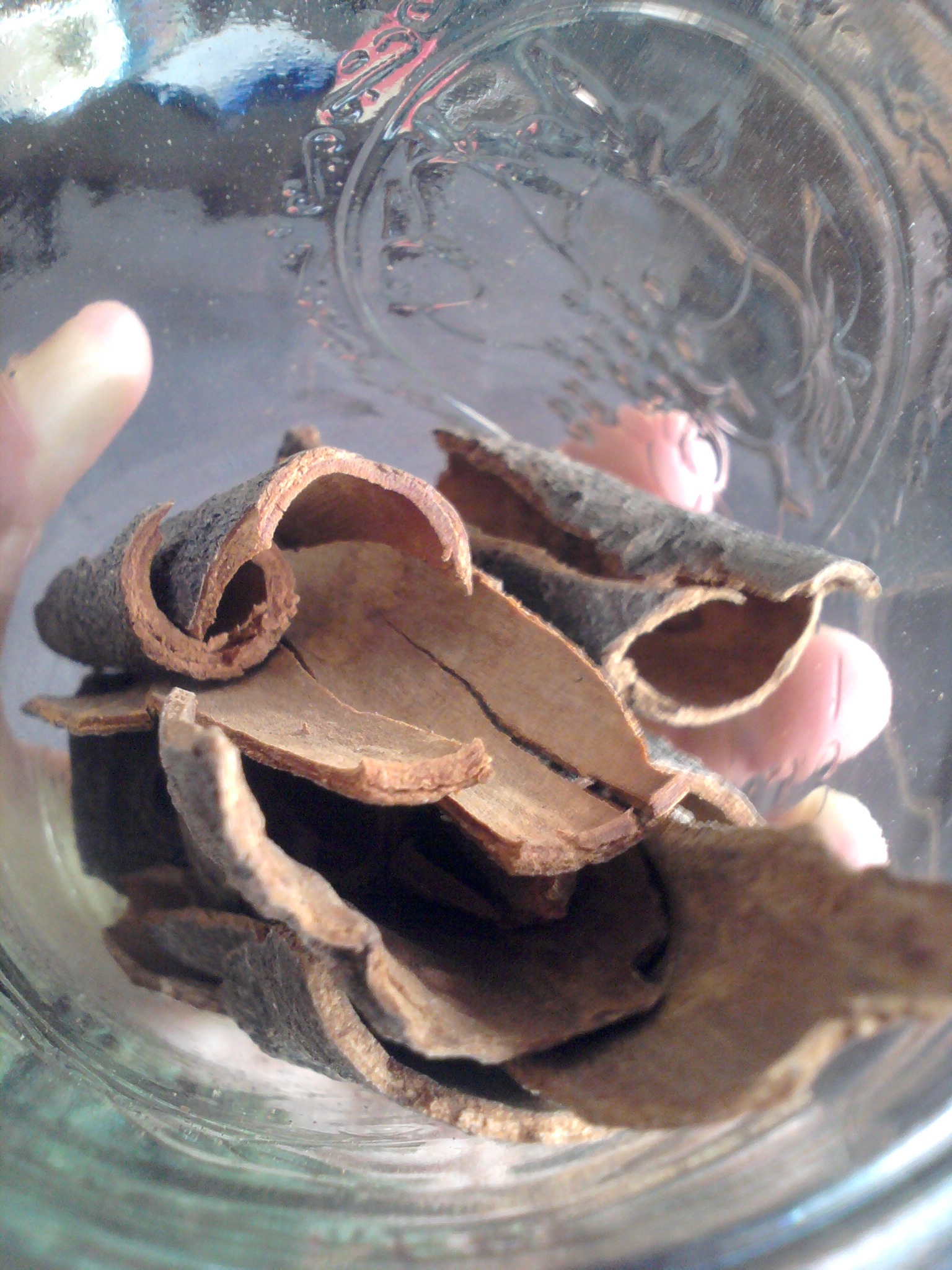
Following are pictures of two types of cinnamon (stored in glass jars) that we very commonly use:
In this picture I’m holding cinnamon bark, an herb categorized as “Warm the Interior, Expel Cold.” It’s commonly used to help resolve symptoms such as wheezing, menstrual cramps, and diarrhea.
This is cinnamon twig and is categorized as a diaphoretic herb. Its common uses include combination with other substances in cases of fever and chills and other body pains, like muscle cramps.
The most traditional way of consuming such herbs is to boil and simmer one’s herbal formula in water as directed, and then to drink the resultant liquid (either warm or room temperature) at prescribed dosages. At VCA, we call these decoctions “teas,” although there is no actual tea leaf in them.
Here’s one morning’s dose of the “tea” I’m currently drinking. It’s beside the sippy cup for size comparison.
My tea happens to be very dark. Obviously color and taste are dependent upon the ingredients, which are in turn dependent upon each case at hand.
Many people love the concept and process of cooking and drinking their own herbal formulas. There’s something soothing and healing about that for lots of folks. Many, too, enjoy getting familiar with the different flavors and their effects in the body. They get a kick out of noticing how the tea makes them feel.
And some people find such a process to be achingly annoying. For them, we have “teapills.” These are herbs that have been decocted and dried into pills:
Teapills are also really handy when you’re traveling, or if you’re too sick to stand up and cook herbs. They can also be an entrypoint into herbal medicine. I remember in my own experience, I was skeptical and dismissive of teas. I (somewhat disbelievingly) took the teapills until I realized they made a great impact on my symptoms. Then I thought I’d much rather have a custom formula made just for me, so I switched over.
Tinctures – herbs soaked in alcohol or glycerin and taken in dropper form – are another quick and easy way to get herbal medicine into a body on the go. They can be taken directly or added to hot water and drunk as a warm beverage.
At VCA we also offer custom essential oil blends. This is herbal medicine, but of a different sort. Instead of ingesting the herbs, these oils are applied to certain acupuncture points. This can be a great way to continue treatment at home when multiple, consecutive treatments are indicated.
What we eat and how we eat it greatly influence how we feel. Understanding the process and preferences of your digestive system will help you to get the most nourishment from your food. In Chinese medicine, dietary therapy is often considered the first step of treating disease. It can help you to feel more energy, alertness, and overall health.
Digestion pertains to the earth element. It is the foundation on which overall health is built. The earth element signifies the possibility for a stable center, both in the body and in one’s life. This means having steady resources to support not only physiology but also how we think and feel. In one’s life, the health of the earth element is reflected in the state of one’s home and in how – or if – one cooks.
The organs and channels associated with the earth element are the spleen and stomach. Their job is to transform everything we eat and drink into nourishment. This process is not all that dissimilar to cooking a soup. If the stomach is likened to a pot, then the spleen (sometimes considered the pancreas) is the fire underneath, and the soup in the pot is the food to be digested. As the soup cooks, it changes, and the end product is very different from the various raw ingredients. So, too, the food in the stomach is transformed and made ready to be transported to nourish and energize the body where it is needed.
Digestion does not always go so smoothly. Sometimes the fire gets smothered, the soup gets burned, or the cook quits. Here are some ways to promote healthy digestion and overall health:
Enjoyment: Let eating be enjoyable and relaxing, not something to belabor with inflexible regimentation. The guidelines set out here are intended to help you get started in paying attention to your body’s needs because the best way to know your own optimum diet is to start noticing how you feel after you eat. Then you can fill your diet with the foods that make you feel best.
Chewing: The mouth is your one chance to break down food into the form that the spleen and stomach need. Inadequate chewing often results in poor digestion and upset to these organs. A good rule of thumb is to chew your food until you can no longer distinguish what you ate by its texture, i.e. when it no longer feels like what it was.
Environment: Pay attention to your eating environment and make any necessary adjustments so that it is relaxing, enjoyable, and suitable for assimilation. This means focusing your body’s energy on digestion by sitting and refraining from distractions like reading, watching television, or heated discussion.
Habits: Don’t stand and eat. Find a nice sitting spot and stay put until you’re finished. Be careful not to overeat. If your belly feels full after a meal, there may not be enough room in your stomach for the food to move around and be digested efficiently. Some say that this means stopping while the food tastes best. It also means eating regular meals and healthy snacks so that you are not excessively hungry at a meal. Your body does best if it has nourishment coming in regularly throughout the day. Also, eating a late dinner (after 7 p.m.) tends to strain the stomach qi.
Quality: Take a look at the ingredients listed on the foods you buy. Avoid trans fats (aka partially hydrogenated oils), artificial sweeteners, and high fructose corn syrup. The best way to ensure good quality is to cook your own meals.
When possible, it is best to use fresh, organic, local food. The benefits of this are too numerous to adequately list here. Here’s one of our favorite sources of information. And here’s another. And love this one.
Raw v. cooked: Because the stomach is the cooking vessel and the spleen the cooking fire, foods that are already cooked – or already soup-like – are more easily digested and assimilated. This isn’t to say you should only eat soups, but eating cooked meals is preferable over raw ones. Raw foods are excellent for clearing heat, which is why a salad is so appealing on a hot day. But asking the stomach to assimilate raw ingredients during cold weather – or in the absence of heat – is demanding. Eventually, the digestion will suffer.