A rose by any other name… (language and medicine)

by Mary Beth Huwe

“What’s in a name?” muses Juliet Capulet as she ponders her taboo love for Romeo Montague. Does what we call something really change that thing’s essence? Though Juliet is right that a rose “would smell as sweet” if we called it a carbuncle, there is something meaningful about how we use language to name a thing. Language is powerful and reinforcing. We use it casually, and yet it still informs our experience.

Stop and smell the carbuncles.

There’s a language-based joke that runs around the area where I’m from, commonly told among older men. “When I was growing up,” they’ll say, “I thought my name was git wood.”  In other words, their youthful interactions with their fathers consisted of being commanded to bring wood inside for the stove. The meaning here, though different than Juliet’s question, points at the same truth… what we call something is a reflection of how we continually perceive that thing to be.

Sure, we can distance ourselves from the language we use. We are conscious beings and many are our powers, so we can easily toss blanket terms over the whole lot of our expression and intend something different from what we say. We can numb ourselves to the powers of our language. Yet, I’d argue that such speech is a contortion of the self and the mind. When possible, it seems better to name things straightforwardly, and with specificity.

This is not as easy as it might seem, and it’s why top-dog marketers and advertisers get paid the big bucks. In my field, it’s especially awkward. I am an acupuncturist and an herbalist, and those are the terms I tend to use to identify myself. My discipline is Chinese medicine, and within that I practice classical Chinese medicine. But I am not Chinese. I don’t even read or speak Chinese.

For a connection to the classical Chinese medical texts and the medicine’s cultural and philosophical roots, I rely on written translations and verbal interpretations from my preferred lecturer, Jeffrey Yuen. For a connection to the medicine itself and its unfolding, I rely on my experiences in the treatment room.

So is it really “Chinese medicine?” Well, in a certain way, absolutely. When I hear Jeffrey talk about the meaning of a word or a concept that I casually use in the practice of Chinese medicine, I am amazed at the depth and significance of cultural references that escape me entirely, having grown up in the Appalachian mountains of Virginia. This is why dialogue and active listening are enriching and important in this (and every) practice.

But in a certain other way, it is not simply “Chinese medicine.” Like language, Chinese medicine is something that belongs to those who use it. Growing up in the Appalachian mountains of Virginia does not exclude me from practicing acupuncture and herbal medicine, as conceived of by the Chinese. It makes sense for me to keep listening and learning about the roots of this medical art. And while I’m doing that, I also recognize that as the many iterations of Chinese medicine are disseminated and take root in the US, the medicine will begin to change. Like any art, this is a dynamic engagement that shifts with time and practice.

The National Institute of Health (NIH) has a division called the National Center for Complementary and Alternative Medicine (NCCAM) whose raison d’etre is to investigate and understand medical practices that are outside the mainstream. The NCCAM site estimates that about 40% of Americans, “use health care approaches developed outside of mainstream Western, or conventional, medicine for specific conditions or overall well-being.” (Source.)

NCCAM also asks “what’s in a name?” and defines the terms complementary, alternative, and integrative as applied to healthcare. How these terms and classifications change – indeed, how we change them – as the face of healthcare evolves in this country, is up to us all.

Coincidence? I think not.

by Mary Beth Ladenheim

A phenomenon that we regularly see in the acupuncture clinic occurs when a person receives treatment, feels better, and then wonders if this was merely coincidence.

I mean, they might say, would I have felt better anyway?

Let’s take the example of a patient who injured her knee. This was not her first knee injury, and each time the healing pattern was slow and laborious. She came in while the injury was still acute, and saw increased mobility and decreased pain. She had a healing time of about 2 days – compared to her usual 2 weeks. And she asked, “Would this have happened anyway?”

It’s good to examine whatever treatment we decide to undertake to make sure that it makes sense for us. And in that examination, the above is a good question to ask, in general.

But I’m most interested in what it reveals about us and our beliefs. It seems likely that we ask the question because we’re separated from ourselves, and we don’t really understand how natural medicine works.

Most people will agree that acupuncture and herbal medicine are natural medicines, and that somehow that’s not the same as “Western” medicine. But often the same people expect the two medicines to behave alike, even though they acknowledge that these medicines differ conceptually.

One way to look at the difference is to examine the language the medicine uses to describe its methodology. It is not uncommon in biomedicine to talk in combative terms. We are accustomed to “fighting” a disease, “killing” cancer cells, or “going under the knife.” Generally, a substance or a surgery is introduced to overcome that which is occurring in the body.

Often, the patient views the sickness as something separate from himself, like a rebelling force that needs to be squelched. In acupuncture and herbal medicine, we have a different kind of language.

We talk about “releasing” pathogens, “clearing” heat, and “building” fluids. In other words, we are interested in reminding the body of what it already knows how to do. Sometimes a light reminder will do. Other times we remind a little more loudly.

This truth calls for an adjustment of our expectations. I’m not saying we should expect natural medicine not to work. It should work. We just shouldn’t expect it to behave and feel like biomedicine, because it doesn’t and it won’t.

So how does it behave and feel?

The answers are as varied as the people who experience the sensations. My personal experience was a certain type of physical and mental awakening. The specific symptoms for which I first sought acupuncture diminished, yes, but even more exciting was the development of an ability to connect more deeply to my body. W

ith monthly treatments and my active participation, I felt my perceptions shift. It was as if I received a bonus sense, one that combined with and brought a glow to all of my usual senses. This is not exactly measurable, but it is very real.

Many people report a similar experience. They notice improvements in their senses; they feel sturdier; gross processed food suddenly tastes gross and processed. (It’s a good thing when what’s bad for the stomach tastes nasty to the tongue!)

In short, acupuncture and herbs help the body begin to be an assimilated whole. Physiological processes that were before jerky or pathological can again become smooth. Such a feeling is so right, so human, and so natural that it can be easy to forget to trace it back to the treatment.

Eye of newt begone! Herbs are medicine.

by Mary Beth Ladenheim

A November 8 Huffington Post story highlighted 25 herbs they’re calling among the “Best For Your Body.”

Of that list, we use 17 in Chinese herbal medicine. Licorice, mint, nutmeg, rosemary, schizandra, saffron, turmeric, ginseng, ginger, fennel, dandelion, cinnamon, burdock, and astragalus are all used in herbal preparations made for ingesting. Lavender, rosemary, oregano, and thyme are used in essential oil blends that are applied topically to acupuncture points.

It can be a shift in thinking for people to consider herbs – something they typically use “just” for seasoning – as medicine. As is often the case, we can recognize the potential of these things if we consider what happens when we overdo it. I remember, for example, putting way too much chili powder in a batch of homemade chili. I was sweating after 3 bites. Same thing with the excessive cinnamon in last week’s applesauce. Probably you can think of a similar situation from your experience. Garlic? Ginger? Salt?

Many people can accept that herbs can have certain physiological effects on the body; some of the most acknowledged are sweating, reflux, diarrhea, calming, and death.  So why is it hard to believe that when used intentionally and with knowledge, herbs can create great change in the body and can revolutionize a person’s sense of health? My theory is that people are skeptical because many are the rotating fads of supplementation and pill-popping, and few are the educated herbalists. But why are there so few well-educated herbalists? I’m not entirely sure, but I think it is intimately related to the fact that herbal medicine does not enjoy firm footing in mainstream American culture as a serious medicine. Here it is considered outdated, dangerous, or esoteric. If plant substances are considered in the US for medicinal purposes, it is most often in terms of specific components to extract for use in pharmaceuticals.

But in China, herbal medicine was one of the official medicines. Today there remain literally thousands of years worth of information regarding the use of natural substances for medicinal use – plants, fungi, animals, and minerals.

The Chinese Herbal Medicine Materia Medica (Bensky, et al.) serves as one of the major texts in most Chinese herbal medicine programs in the US. It includes information, discussion, and comparisons of 480 “principal herbs” and “an additional 52 herbs” with brief information. Almost all of those herbs are in routine use today. Older herbal compilations have included thousands of substances. The substances are grouped into categories that are indicative of their functions: “Transform Phelgm and Stop Coughing,” “Drain Dampness,” “Calm the Spirit.” Their properties and varieties are noted along with preparations and cautions, as well as the channels they enter. All of this information is taken into account when the herbalist prepares a formula.

It’s a big book. And the print is little. There’s a lot to say on the subject.

Let’s start with internal herbal medicine, by which I mean herbs that one ingests. These herbs (or substances, as mentioned above) are used in combination with each other to make one custom formula for the patient. Each formula usually has between 9-15 different ingredients, although this can vary. It’s pretty unusual for a formula to contain fewer than 6 herbs, but it does happen.

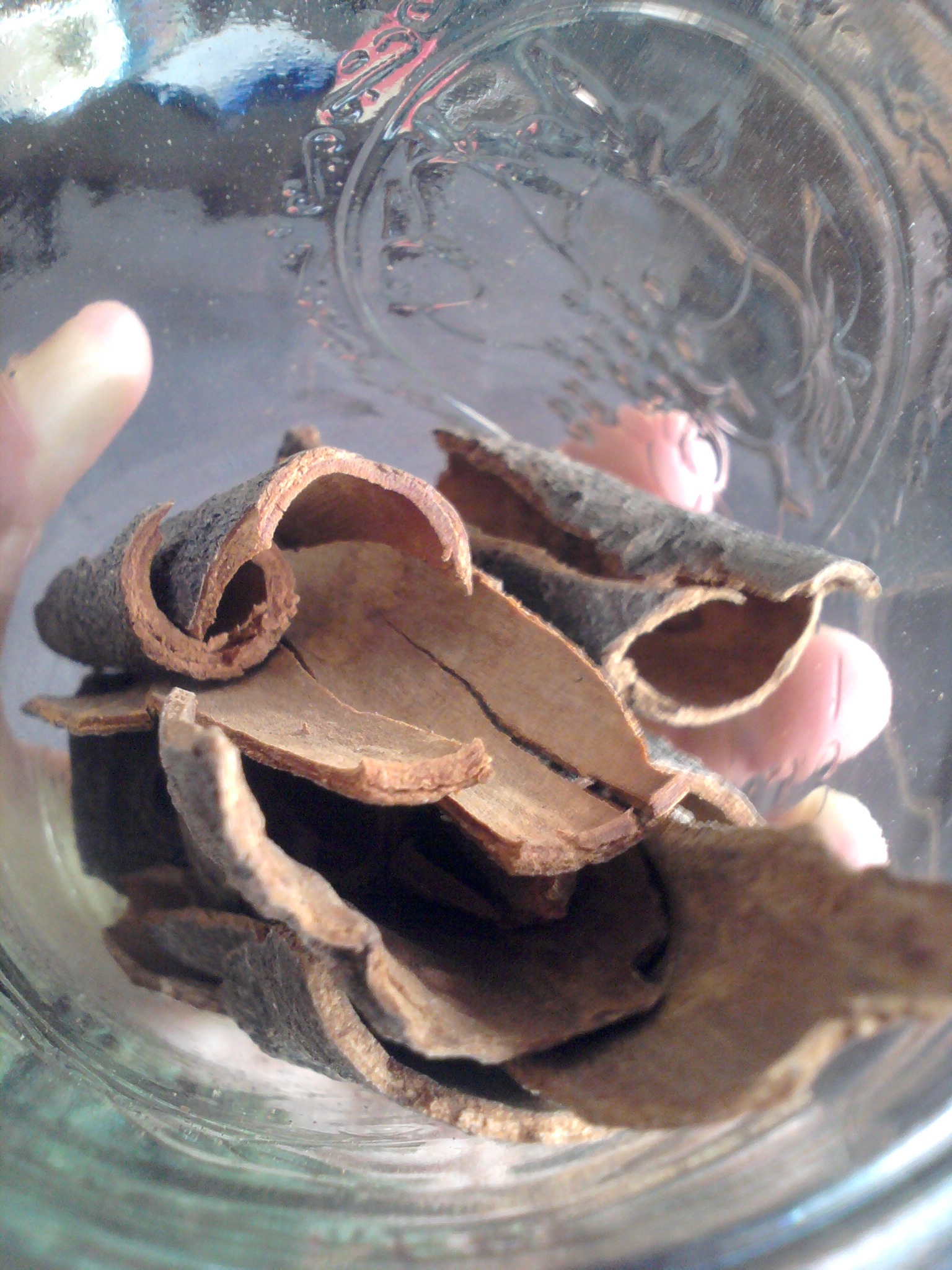
Following are pictures of two types of cinnamon (stored in glass jars) that we very commonly use:

In this picture I’m holding cinnamon bark, an herb categorized as “Warm the Interior, Expel Cold.” It’s commonly used to help resolve symptoms such as wheezing, menstrual cramps, and diarrhea.
This is cinnamon twig and is categorized as a diaphoretic herb. Its common uses include combination with other substances in cases of fever and chills and other body pains, like muscle cramps.

The most traditional way of consuming such herbs is to boil and simmer one’s herbal formula in water as directed, and then to drink the resultant liquid (either warm or room temperature) at prescribed dosages. At VCA, we call these decoctions “teas,” although there is no actual tea leaf in them.

Here’s one morning’s dose of the “tea” I’m currently drinking. It’s beside the sippy cup for size comparison.

My tea happens to be very dark. Obviously color and taste are dependent upon the ingredients, which are in turn dependent upon each case at hand.

Many people love the concept and process of cooking and drinking their own herbal formulas. There’s something soothing and healing about that for lots of folks. Many, too, enjoy getting familiar with the different flavors and their effects in the body. They get a kick out of noticing how the tea makes them feel.

And some people find such a process to be achingly annoying. For them, we have “teapills.” These are herbs that have been decocted and dried into pills:IMG_0682

Teapills are also really handy when you’re traveling, or if you’re too sick to stand up and cook herbs. They can also be an entrypoint into herbal medicine. I remember in my own experience, I was skeptical and dismissive of teas. I (somewhat disbelievingly) took the teapills until I realized they made a great impact on my symptoms. Then I thought I’d much rather have a custom formula made just for me, so I switched over.

Tinctures – herbs soaked in alcohol or glycerin and taken in dropper form – are another quick and easy way to get herbal medicine into a body on the go. They can be taken directly or added to hot water and drunk as a warm beverage.

At VCA we also offer custom essential oil blends. This is herbal medicine, but of a different sort. Instead of ingesting the herbs, these oils are applied to certain acupuncture points. This can be a great way to continue treatment at home when multiple, consecutive treatments are indicated.